
The Power of Many: What Iceland’s Story Reminds Us About Women’s Leadership
Article
Written by Paddi LeShane, October 2025
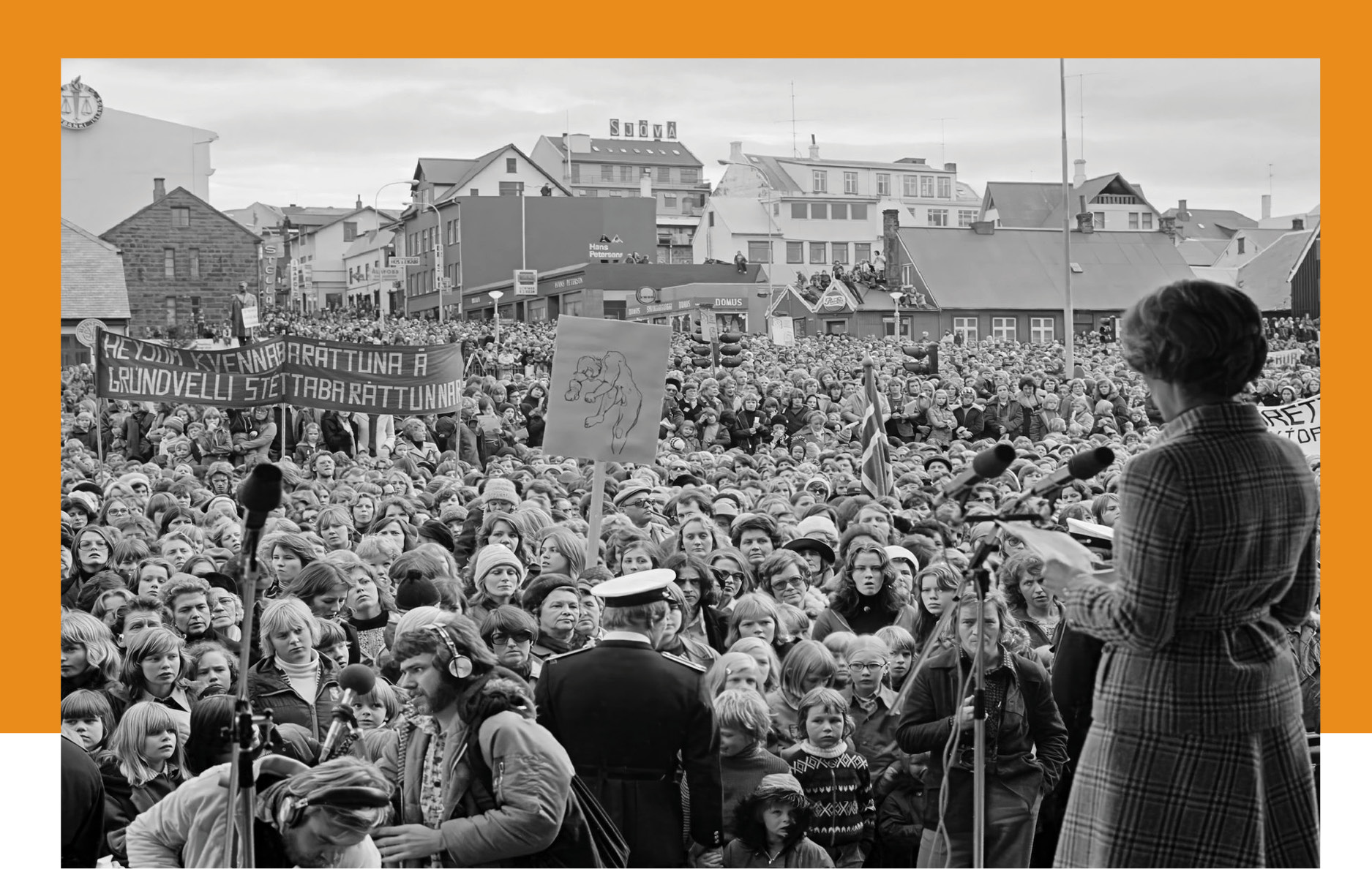
This past weekend, IWFCT members, Jill Adams, Barbara Hopkins and myself joined a full room at the Norfolk Library in Connecticut’s northwest hills for a watch party of a new documentary capturing one of the most extraordinary moments in modern women’s history: Iceland’s “Women’s Day Off.” Nearly 80% of the country’s female residents—across every profession, neighborhood and age group—walked not to their jobs or stayed at home for the day but to the city centers across the country to make one unmistakable point: when women stop, the country stops.
The documentary doesn’t dwell on the drama of protest. Instead, it reframes the moment as a social and cultural reckoning—a reminder of just how invisible women’s contributions often become when they are woven so seamlessly into the fabric of society. That, more than anything, is what stayed with me as the credits rolled.
The Real Impact: Clarity, Not Chaos. What struck us most wasn’t the scale of the action, but the clarity that followed. Icelanders didn’t just witness inconvenience that day; they witnessed truth. Schools struggled, businesses closed early, hospitals reorganized, and families rearranged their entire routines and the media had to scramble to cover the news while their heart and soul were the news. The documentary presents this not as disruption, but as revelation. When work is made visible, value becomes seen.
What followed in Iceland over the next decades—policy shifts, more women in leadership, expanded equity measures—didn’t happen because one event forced the government’s hand. They happened because the public could no longer un-see women’s central role in national life. That cultural shift is the real story, and the documentary makes this point with humility, humor and power.
The Power of Many. There’s a line in the film that made the entire room fall silent: “One woman can be ignored. A nation of women cannot.” The power of many is not about volume or confrontation. It’s about alignment.
What Iceland’s women did so effectively—and what the documentary captures beautifully—it reminded us that collective action does not require perfect agreement. It only requires shared purpose. Across generations and political perspectives, women in Iceland recognized a simple truth: progress accelerates when we move together, even briefly.
In professional women’s networks, leadership circles, and workplaces across the U.S., we often talk about collaboration, mentorship, and solidarity. Iceland offers a vivid example of what that actually looks like when lived in real time. It’s less about speaking in unison and more about the quiet power of showing up—together.
What This Means for Us. Leaving the watch party, you couldn’t keep from thinking about how this story translates to our own communities. While culture, politics, and history differ, several lessons resonate for professional women today:
1. Visibility matters—sometimes more than strategy.
The documentary shows that when contributions are visible, conversations change. For women in leadership, entrepreneurship, and the professions, this reinforces the importance of naming our work, documenting our impact, and advocating for each other’s accomplishments.
2. Solidarity multiplies influence.
Women don’t need to react to crisis to stand together. Everyday collaboration—sharing opportunities, amplifying other women’s achievements, mentoring emerging leaders—creates the same cumulative force.
3. Equality is cultural before it is structural.
Policies follow perception. Iceland’s transformation began the moment the nation understood women’s role more fully. That shift can happen anywhere, including here, when organizations make women’s leadership visible and valued.
4. Small groups can spark big change.
The documentary highlights the women who planned the 1975 event—young, unknown organizers who simply believed the country could be better. Their story is a reminder that influence often begins in small rooms with committed people.
A Final Reflection
What struck me most in the documentary wasn’t just the power of collective action—it was the reminder that women’s progress is shaped every day by how we treat one another. Iceland’s story shows that unity isn’t automatic; it’s a choice. Sometimes, it means resisting the instinct to question another woman’s path simply because it looks different from our own.
We’ve all seen it—at work, in leadership circles, even in our communities. Expectations run high, visions differ, and judgment can creep in. Yet Iceland’s achievement wasn’t built on perfect agreement. It was built on grace—on giving one another the benefit of the doubt and making room for different voices.
The lesson is simple: women’s impact grows when we show up not only with ambition and skill, but with generosity, curiosity, and a commitment to lift one another. That’s how cultures shift, possibilities expand, and together, we move farther than any of us could alone.
The three of us all agree: the International Women’s Forum of Connecticut provides exactly that—recognition, support, and a community where women’s successes are celebrated and multiplied. Here, we lift one another higher—and together, achieve far more than any of us could alone.